
This conventional eastern blade serves as a impressive display of technique, but what if you seek to express your unique mode? Adapting your tool is a meaningful journey, allowing you to fashion a truly distinctive piece. From the shaft wrapping and habaki to the handpiece design and heat mark, each aspect offers a chance for tailored look. This investigation delves into the sphere of katana refinements, providing details for both initiates and experienced enthusiasts wanting to imprint their stamp on the historic art of the samurai.
Starter True Handiwork
For enthusiasts determined to embark on the rewarding journey of katana handling skills , 1060 steel katanas bring an superb entry point. This certain grade of elemental-based steel obtains a sweet spot between price and capability . While below hard as supreme steels, 1060 allows for a manageable level of honing , making it ideal for starters to cultivate the preliminaries of sword maintenance and appreciate the elegance of expertly made Japanese weaponry. It’s a remarkable choice for building experience without the budgetary burden of more complex steels.
Type T10 Cutting Tools : Harmonizing Functionality and Expense
Providing for devotees seeking an authentic armament experience without overpowering the cash reserve , T10 substance katanas represent a beneficial option. These daggers offer a marked improvement in endurance compared to less expensive alternatives, exhibiting acceptable edge retention and adequate flexibility for basic cutting techniques. While not rivaling the exquisite characteristics of ultimate steels like T100 or folded substance , T10 provides a distinguished blend of utility and price , making them a common choice for beginners and those on a narrow salary .
Exceeding the Steel : Customizing Your Weapon's Ornaments and Hilt
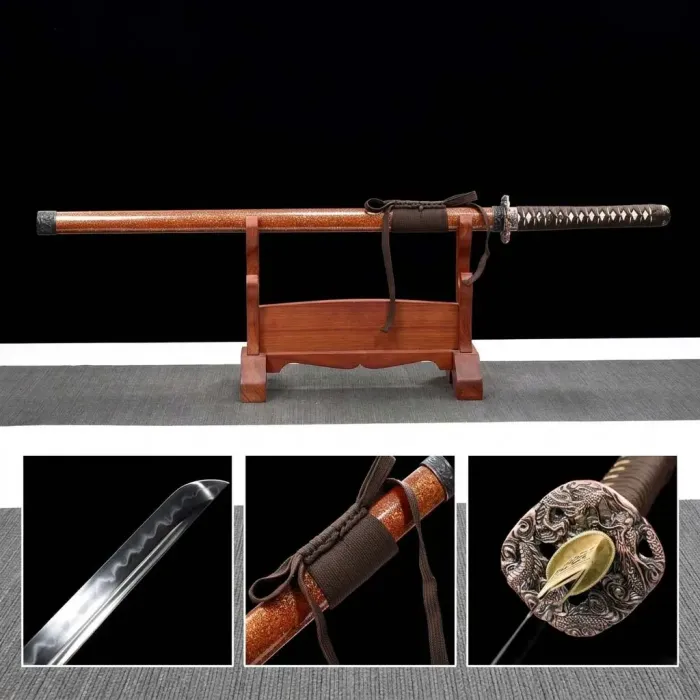
Although the glazed cutting edge is undeniably the main point of a katana, truly refining its magnificence lies in the deliberate customization of its ornamentation and hold. This technique allows collectors to present their exclusive preference . Assess the extensive possibilities: menuki - decorative decorations that bring visual interest ; the hamon protective covers – often carefully engraved ; the tsuka center itself, wrapped in orthodox ito yarn; and the fusa cap, which can be created from various materials like ingots or bone .
- Decide on motifs that match with you.
- Investigate with various components .
- Accent craftsmanship for a continuing impact .
Conclusively , customizing these parts transforms a splendid weapon into a remarkably tailor-made work of mastery.
The Allure of the Katana: History, Craftsmanship, and Steel
This traditional armament bears a unparalleled allure, steeped in centuries of the nation's history and folklore . More than merely a weapon of combat , it's a mark of the fighter class ethos – a fusion of mastery and governance . Its expansion spanned numerous generations, with early edges evolving into the sophisticated curvature and effective edge we acknowledge today. The fabrication involved is truly phenomenal , requiring epochs of training to master . The process involves a involved folding of refined metal , creating layers that fortify the blade's flexibility and slicing ability. Multiple schools of crafting appeared , each with their special secrets and formulas for achieving the ideal equilibrium and edge - a truly strenuous pursuit.
- Primary Katana varieties
- The responsibility of the historical weapon in champion culture
- Traditional smithing methods
Deciding the Best Steel for Your Bladed Weapon Project: 1060 vs. T10
Deciding on the suitable steel is remarkably important for any blade project, and the selection between 1060 and T10 can be challenging. 1060 is a widely used American metal, offering a decent balance of strength and toughness, making it appropriately easy to condition. However, T10, a Far Eastern steel, ordinarily boasts increased wear sustainability and can conceivably achieve a more ultimate hardness, although it can be somewhat difficult to treat and requires thorough heat annealing. Consider your proficiency and projected outcomes: for a trainee, 1060 may be a safer launchpad, while the proficient smith might favor the additional details of T10.
- Manageability of Applying
- Abrasion
- Final Stiffness
Unlocking the Potential: Advanced Katana Customization Techniques
Mastering the art of katana alteration extends far beyond basic buffing. Serious smiths are now researching advanced techniques to truly unleash a blade's hidden potential. This involves intricate work with the temper rim, utilizing specialized elements for differential hardening and carefully electing the shape of the crossguard to optimize balance and capability. Beyond purely functional adjustments, artisans are increasingly focused on developing unparalleled aesthetic beauty, through complex decorating and layered surfaces that truly transform a katana into a exquisite object.
Forging a 1060 Katana: From Raw Metal to Masterpiece
The journey originates with conventional 1060 alloy , a robust material far removed the ornate katana it will change . Talented bladesmiths use a detailed process of layering and forming the raw steel, repeatedly burning it and flattening it to extract impurities and establish a uniform grain structure. This exhausting process, often going on for months , builds the imperative strength and give characteristic of a legitimate Japanese sword . Subsequent custom katana heat adjustments , including precise hardening and quenching , are fundamental to achieve the expected equilibrium of sharpness, endurance and splendor .
- Folding: Eliminates impurities and produces grain structure.
- Forming: Fabricates the steel into the initial blade form.
- Tempering: Decides the final hardness and flexibility.
The Persistent Magnetism of the Katana: Thorough Examination of Alloy and Modification
This time-honored katana lasts a powerful symbol for Japanese artistry , its charm far outshining mere artillery . Forged from select steel and usually featuring intricate trims, the process of creation itself is a revered art. Beyond the basic craftsmanship, the ability to modify a katana - from the temper curve to the grip wrapping and clasp - opens for a perfectly individual manifestation for both supporters and operators alike. This union of legacy steelwork and boundless personalization effectuates the katana's continued prestige across the terra .
Comments on “Can leveraging collector feedback refine your wakizashi product‑market fit?”